
Carbon Reduction Plan
Carbon Reduction Plan
Summary Statement
Panacea Applications Limited (“Panacea”) has long been committed to creating a positive environmental legacy. Our environmental policy aligns with the key themes of Net Zero and includes a strong commitment to continual improvement and pollution prevention.
Panacea actively promotes the integration of environmental considerations into our wider operational practices, supporting sustainable operations that deliver long-term benefits. Our Integrated Management System ensures robust adherence to environmental standards and is certified to ISO 14001:2015.
We are committed to reducing carbon emissions by prioritising practices that lower the consumption of natural resources and minimise waste.
Commitment to achieving Net Zero
Panacea is committed to achieving Net Zero emissions by 2050.
This Carbon Reduction Plan has been completed in accordance with PPN 06/21 and associated guidance and reporting standards for Carbon Reduction Plans.
Please note that 2022 was our first reporting year for Scope 3, so our baseline emissions and 2022 emissions falling under Scope 3 are the same.
Baseline Emissions Footprint
Baseline emissions represent the greenhouse gases produced prior to implementing emission-reduction strategies. These emissions serve as the reference point against which we measure future reductions.
Baseline Emissions
Panacea has calculated baseline emissions for Scope 1, Scope 2, and a subset of Scope 3 emissions. The selected baseline represents typical business operations for these scopes and provides a benchmark for setting reduction targets. Emissions have been monitored since our ISO 14001 certification, with specific reduction targets/objectives implemented in some areas. A subset of Scope 3 emissions has been gathered and calculated for 2022 and 2023 and reported in the “Previous Year’s Emissions Reporting” and “Current Emissions Reporting” sections. These cover the following Scope 3 subcategories:
- Purchased Goods and Services
- Business Travel
- Employee Commuting
- Waste Disposal
- Homeworking
The following Scope 3 subcategories do not apply to our business:
- Transportation and Distribution: There is no physical transportation involved in the distribution of most of our purchased services (e.g., hosting, penetration testing) or in the provision of our online software products.
- Investments: Our business is not engaged in any investments.
- Leased Assets and Franchises: We have no activity related to leased assets or franchises.
- Use of Sold Products: Our product is online software, and the emissions resulting from its use come from servers owned by another company. These emissions are already covered under the “Purchased Goods and Services” category.
Calculation of Scope 1, 2 & 3 Emissions
Scope 1, 2 & 3 Emissions have all been calculated using the UK Government GHG Conversion Factors, with the exception of the emissions from our data centre and servers. This figure has been provided by iomart Managed Services Ltd, the company that owns and manages the servers. It represents the estimated proportion, based on average figures, of the total tCO2 reported in 2024 for the two data centres housing the servers used by Panacea Software.
We have not calculated emissions for products where UK Government conversion factors are not available. For example, all the computer equipment which Panacea bought in the years 2023-26 was refurbished, meaning they were built with recycled materials. There are no conversion factors available for such products, so we have simply written “Reliable data not available”.
Panacea has been unable to collect precise data on waste disposal. However, waste generation is minimal and does not represent a significant part of our operations. It primarily consists of small amounts of general waste (e.g., unsolicited marketing literature, food packaging from staff lunches and very occasional printouts) collected by the council.
Similarly, the purchase of general office equipment during 2025 was minimal, as Panacea is a small company that is now largely paperless. Most of our processes are conducted online, reducing the need for office equipment.
There were no UK Government GHG conversion factors available for the Homeworking category in 2021 when our baseline plan and data were first reported. Our targets have since been adjusted to reflect the introduction of these factors.
When calculating Scope 3 emissions, the following guidance was used or observed:
- Greenhouse gas reporting: conversion factors 2022 https://www.gov.uk/government/publications/greenhouse-gas-reporting-conversion-factors-2022
- Greenhouse gas reporting: conversion factors 2023 https://www.gov.uk/government/publications/greenhouse-gas-reporting-conversion-factors-2023
- Greenhouse gas reporting: conversion factors 2024
https://www.gov.uk/government/publications/greenhouse-gas-reporting-conversion-factors-2024
- Greenhouse gas reporting: conversion factors 2025
https://www.gov.uk/government/publications/greenhouse-gas-reporting-conversion-factors-2025https://ghgprotocol.org/standards/scope-3-standard
Baseline Year Emissions
|
Baseline Year |
2021 (Reporting period: 1 January 2021 to 31 December 2021)
|
|
Total Emissions |
6.15 tCO₂e
|
|
Scope 1 |
0.98 tCO₂e – Gas
|
|
Scope 2 |
1.37 tCO₂e – Electricity
|
|
Scope 3 |
2.99 tCO2e – Purchased Goods and Services
0.40 tCO2e – Business Travel
0.41 tCO2e – Employee Commuting
0.00 tCO2e – Waste Disposal
0.00 tCO2e – Homeworking*
0.00 tCO₂e – Use of sold products We sell online software, and the emissions resulting from its use come from servers provided by our hosting company which are already covered by the ‘Purchased Goods and Services’ category 0.00 Upstream transportation and distribution The services we purchase for our SaaS business do not require physical transportation 0.00 Downstream transportation and distribution There is no physical transportation involved in the distribution of our products, which are online software solutions |
Previous Year’s Emissions Reporting
|
Reporting Year |
2022 (Reporting period: 1 January 2022 to 31 December 2022)
|
|
Total Emissions
|
12.73 tCO₂e |
|
Scope 1 |
0.91 tCO₂e – Gas
|
|
Scope 2 |
1.25 tCO₂e – Electricity
|
|
Scope 3 |
2.99 tCO2e – Purchased Goods and Services
0.40 tCO2e – Business Travel
0.41 tCO2e – Employee Commuting
0.00 tCO2e – Waste Disposal
6.77 tCO2e – Homeworking
0.00 tCO2e – Use of Sold Products 0.00 tCO2e Upstream Transportation and Distribution 0.00 tCO2e Downstream Transportation and Distribution |
|
Reporting Year |
2023 (Reporting period: 1 January 2023 to 31 December 2023)
|
|
Total Emissions
|
14.56 tCO₂e |
|
Scope 1 |
1.40 tCO₂e – Gas
|
|
Scope 2 |
0.98 tCO₂e – Electricity
|
|
Scope 3 |
0.78 tCO2e – Purchased Goods and Services
0.07 tCO2e – Business Travel
0.80 tCO2e – Employee commuting
10.53 tCO2e – Employee homeworking = 10,534 kgCO2e 0.00 tCO2e – Waste Disposal
0.00 tCO2e – Use of Sold Products We sell online software, and the emissions resulting from its use come from servers provided by our hosting company which are already covered by the ‘Purchased Goods and Services’ category 0.00 tCO2e Upstream Transportation and Distribution The services we purchase for our SaaS business do not require physical transportation 0.00 tCO2e Downstream Transportation and Distribution There is no physical transportation involved in the distribution of our products, which are online software solutions |
|
Reporting Year |
2024 (Reporting period: 1 January 2024 to 31 December 2024)
|
|
Total Emissions
|
16.16 tCO₂e |
|
Scope 1 |
1.37 tCO₂e – Gas |
|
Scope 2 |
0.79 tCO₂e – Electricity |
|
Scope 3 |
0.78 tCO2e – Purchased Goods and Services
0.02 tCO2e – Business Travel
1.34 tCO2e – Employee Commuting
0.00 tCO2e – Waste Disposal
11.86 tCO2e – Employee Homeworking = 11867.71 kgCO2e 0.00 tCO2e – Use of sold products We sell online software, and the emissions resulting from its use come from servers provided by our hosting company which are already covered by the ‘Purchased Goods and Services’ category 0.00 Upstream transportation and distribution The services we purchase for our SaaS business do not require physical transportation 0.00 Downstream transportation and distribution There is no physical transportation involved in the distribution of our products, which are online software solutions |
Current Emissions Reporting
| Reporting Year | 2025 (Reporting period: 1 January 2025 to 31 December 2025) |
| Total Emissions | 10.39 tCO2e |
| Scope 1 | 0.14 tCO2e – Gas |
| Scope 2 | 0.66 tCO2e – Electricity |
| Scope 3 |
0.79 tCO2e – Purchased goods and services
0.10 tCO2e – Business Travel
1.24 tCO2e – Employee commuting
7.46 tCO2e – Employee homeworking = 7467.3 kgCO2e 0.00 tCO2e – Waste Disposal
0.00 tCO2e – Use of Sold Products We sell online software, and the emissions resulting from its use come from servers provided by our hosting company which are already covered by the ‘Purchased Goods and Services’ category. 0.00 tCO2e Upstream Transportation and Distribution The services we purchase for our SaaS business do not require physical transportation. 0.00 tCO2e Downstream Transportation and Distribution There is no physical transportation involved in the distribution of our products, which are online software solutions. |
Priorities to achieve Net Zero
In order to continue our progress to achieving Net Zero, we have adopted the following carbon reduction targets.
- Panacea is committed to achieving net zero emissions across all its activities by 2050.
- This target includes the full activity of our supply chain working on our behalf.
- This target includes all emission sources covered in PPN06/21.
To achieve these objectives, we will continue to assess activities associated with scope 1, 2 and 3 emissions, such as looking to reduce our consumption of electricity and natural gas.
Progress against these targets can be seen in the graph below:
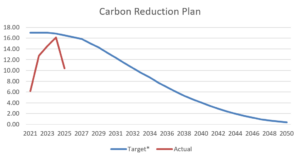
The shape of the graph reflects a change in reporting methodology rather than a direct increase in operational emissions. In 2021, UK Government GHG conversion factors for homeworking were not available and emissions from this category were not reported.
From 2022 onwards, the introduction of UK Government GHG conversion factors for homeworking meant that emissions associated with hybrid and remote working were included. As a result, organisations operating hybrid working models, including Panacea, saw an increase in reported emissions for this category.
Emissions from employee commuting and homeworking increased in 2024 due to higher staffing levels. However, in 2025, the company restructured and updated its hybrid working practices, resulting in a decrease in emissions for both employee commuting and homeworking.
The top three actions that Panacea continues to focus on to tackle the global climate emergency are:
1. Energy Saving
Panacea is implementing strategies to promote the efficient use of energy, water, equipment, furniture, and materials, supporting the responsible use of natural resources. Wherever possible, we prioritise the purchase of second-hand or refurbished office furniture and computer equipment.
We are committed to maintaining a hybrid working policy for all relevant staff. We will continue to encourage office-based working where appropriate, recognising that this can be more energy efficient than individual home working in terms of heating and lighting.
Panacea does not provide company cars and actively encourages the use of public transport for commuting and business travel. In 2025, Panacea partnered with Cycle Solutions, our chosen government scheme provider, to offer all eligible employees the opportunity to participate in a cycle-to-work scheme.
2. Purchased Goods and Services
Panacea is committed to reducing CO2 emissions in its hosting infrastructure. The largest proportion of emissions generated by our business arises from the data centres and servers required to host Panacea Software.
Continual adaptation of our hosting infrastructure and architecture to harness the environmental benefits of cloud hosting over on prem servers as the security of these technologies continues to evolve in line with our subscribers’ requirements, represents the greatest opportunity for carbon reduction for our business.
3. Supply Chain
Panacea is committed to operating an environmentally responsible purchasing policy in respect of goods and services, including promoting the adoption of sound environmental principles and practices by suppliers and contractors to the Company. Our hosting is provided by iomart Managed Services Ltd, the UK’s first carbon neutral web hosting provider.
Reporting Standards and Methodology
Emissions have been reported and recorded in accordance with the published reporting standard for Carbon Reduction Plans and the GHG Reporting Protocol corporate standard* and uses the appropriate Government emission conversion factors for greenhouse gas company reporting.**
Scope 1, 2 and 3 emissions have been reported in accordance with SECR requirements, and the required subset of Scope 3 emissions have been reported in accordance with the published reporting standard for Carbon Reduction Plans and the Corporate Value Chain (Scope 3) Standard.***
*https://ghgprotocol.org/corporate-standard
**https://www.gov.uk/government/collections/government-conversion-factors-for-company-reporting
***https://ghgprotocol.org/standards/scope-3-standard
Rachel Wynne, Managing Director
T : 0207 976 0116
2nd March, 2026
More from Panacea
How we work
About us
Find out more
Who we are
Our team
Find out more
Proof and impact
Case studies
Find out more